
Hybrid Car vs EV: Understanding the Key Differences for Modern Drivers
Hybrid Car vs EV is a critical decision modern drivers face when upgrading their ride, whether to stick with familiar gas-powered models or embrace newer technologies. Two leading alternatives now dominate the market: vehicles that blend combustion engines with battery power and those that run solely on electricity. Understanding their differences helps buyers align their choices with personal priorities.
Gas-assisted models use advanced systems to switch between fuel and stored energy, reducing trips to the pump. These options excel for drivers covering long distances or lacking consistent charging access. Meanwhile, fully electric alternatives eliminate tailpipe emissions, appealing to eco-conscious consumers.
Advancements in battery tech and charging infrastructure have made both choices more practical than ever. However, factors like upfront costs, maintenance needs, and local incentives play major roles in determining suitability. Urban commuters might prioritize zero-emission capabilities, while frequent road-trippers could value flexible refueling.
This guide breaks down performance metrics, ownership expenses, and environmental impacts to simplify your decision. We’ll compare real-world benefits without industry jargon, focusing on what matters most for your daily drives and long-term goals.
Key Takeaways
- Evaluate daily mileage and charging access before deciding between technologies
- Upfront costs differ significantly, but long-term savings vary by usage patterns
- Federal and state incentives can offset initial purchase prices
- Maintenance requirements decrease with fully electric models
- Environmental benefits depend on local energy production methods
Overview of Hybrid Cars and Electric Vehicles
The shift toward greener mobility has spotlighted two distinct vehicle categories. Both aim to reduce environmental impact but use fundamentally different approaches. Let’s break down their core characteristics before exploring specific models.
Definitions and Key Terms
Hybrid electric vehicles (HEVs) pair gasoline engines with battery-powered motors. These systems work together to optimize fuel efficiency, automatically switching between power sources. Drivers never need to plug them in; the battery recharges through braking energy.
Battery electric vehicles (BEVs) eliminate gas tanks. They rely solely on rechargeable lithium-ion packs, delivering emission-free operation. Charging stations replace gas stations for these models.
Types and Classifications
Three primary hybrid variations exist:
- Mild hybrids: Use small batteries to assist acceleration
- Full hybrids: Can drive short distances using only electricity
- Plug-in hybrids (PHEVs): Offer 20-50 miles of electric-only range
BEVs represent the purest form of electric transportation. Unlike hybrids, they produce zero tailpipe emissions and require no oil changes. Emerging hydrogen fuel cell models promise another alternative, generating electricity through chemical reactions rather than stored battery power.
Hybrid Car vs EV: A Comprehensive Comparison
The heart of any vehicle lies in its powertrain system. How energy converts into motion determines efficiency, performance, and long-term costs. Let’s explore what happens under the hood.
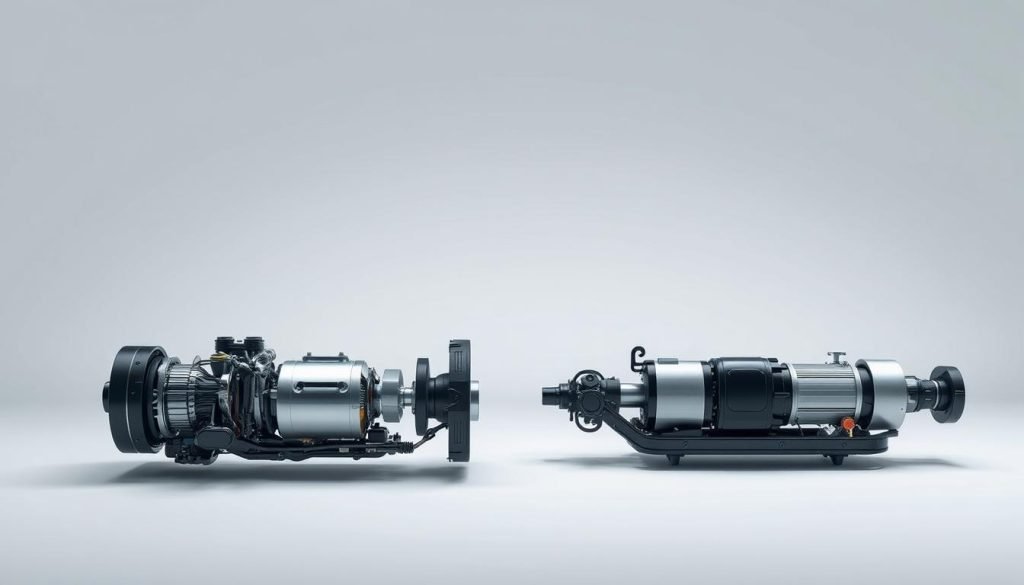
Understanding the Powertrain Differences
Combustion engines remain central to hybrid designs. These work alongside compact electric motors, sharing driving duties. During stops or slow speeds, the battery takes over. At highway paces, gasoline becomes the primary fuel source.
Fully electric models ditch fossil fuels entirely. Their high-capacity battery packs feed energy to robust motors that handle all acceleration and cruising. No pistons, exhaust systems, or fuel injectors means fewer parts needing repairs.
| Component | Hybrid System | Electric Vehicle |
|---|---|---|
| Primary Power Source | Gasoline Engine | Lithium Battery |
| Secondary Power | Electric Motor Assist | N/A |
| Energy Recovery | Brake Regeneration | Brake Regeneration |
| Maintenance Needs | Oil Changes + Motor Care | Battery Checks |
Instant torque defines electric propulsion. Motors deliver maximum thrust immediately, unlike engines that need RPM buildup. This creates smoother acceleration from stoplights.
Complexity varies significantly. Hybrids juggle two systems, requiring more servicing. Electric models simplify mechanics but demand battery health monitoring over time.
Performance, Efficiency, and Environmental Impact
The intersection of engineering and ecology shapes modern transportation choices. While acceleration thrills matter, responsible buyers weigh how their selection affects both their commute and the planet.
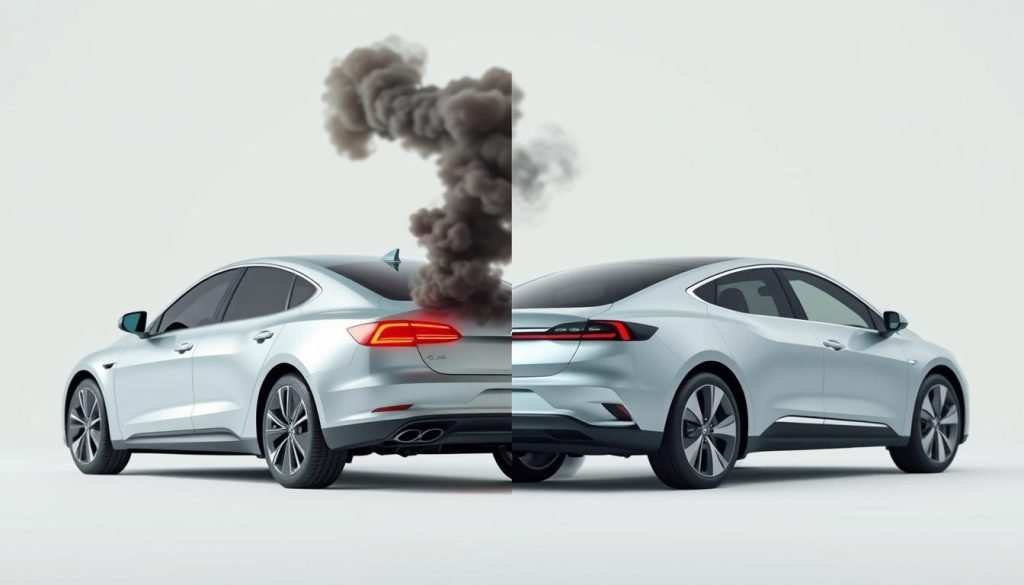
Driving Dynamics and Torque
Instant power delivery defines electric cars. Their motors generate maximum thrust immediately, launching from stops with silent urgency. This contrasts with gas-assisted models that require engine revving to build momentum.
Regenerative braking shines in urban environments. It recaptures kinetic energy during deceleration, replenishing batteries in stop-and-go traffic. Drivers report up to 40% efficiency gains in congested areas using this feature.
Emission and Energy Consumption Analysis
Tailpipe exhaust remains unavoidable for most gas-electric vehicles. Though cleaner than traditional engines, they still release CO₂ during combustion. Fully electric alternatives eliminate this locally but depend on regional electricity sources for true sustainability.
- Energy costs: Battery-powered models average 3-5¢ per mile versus 12¢ for gas
- Grid impact: Charging with solar cuts emissions by 90% compared to coal-powered stations
Battery disposal challenges both technologies. Recycling programs now recover 95% of lithium for reuse, easing landfill concerns. Proper maintenance extends pack life beyond 10 years in most cases.
Cost Considerations: Purchase, Fuel, and Maintenance
Budget-conscious buyers must weigh immediate expenses against future savings when selecting eco-friendly transportation. Financial planning becomes crucial as price gaps between technologies narrow, but ownership experiences diverge.
Upfront Costs vs Long-Term Savings
Gas-assisted models typically enter the market at $25,000-$35,000, appealing to those avoiding premium investments. Battery-powered alternatives start higher, with extended-range versions exceeding $60,000. Budget options like the Chevy Bolt bridge this gap at $35,000.
Energy expenses reveal sharper contrasts. Electricity costs average 4-5¢ per mile versus 6-8¢ for fuel-based systems. Over 100,000 miles, this difference saves $2,000-$4,000. Maintenance amplifies savings—simpler mechanics in battery-powered models cut annual upkeep by $400-$1,000 compared to combustion engines.
Incentives and Tax Rebates
Federal programs dramatically alter affordability calculations. The $7,500 EV tax credit applies exclusively to battery-powered transportation, potentially reducing effective prices below comparable gas-assisted options. State-level perks like HOV lane access add further value.
Owners should consult local utility providers for charging discounts. Some regions offer installation rebates for home charging stations, improving long-term convenience. These financial tools help offset initial premiums while accelerating break-even points.
Charging Options and the Role of Solar Panels
Powering your ride has never offered more possibilities than today’s energy solutions. Drivers can choose between public networks, home setups, or renewable systems to keep their vehicles running. Each method balances convenience, cost, and environmental impact differently.
Public Charging vs Home Charging
Public stations provide fast refueling for on-the-go drivers. DC fast chargers add 180+ miles in 15 minutes but cost $0.28-$0.69 per kWh—up to 3x pricier than home electricity. These work best for road trips or urgent top-ups.
Home charging shines for daily use. Grid-powered setups cost $0.10-$0.40 per kWh, letting you refill overnight while you sleep. Renters face challenges unless their building has existing infrastructure, but homeowners can install dedicated equipment easily.
Benefits of Solar Panel Integration
Solar systems slash charging costs to $0.05-$0.11 per kWh—cheaper than utility rates in most states. Panels generate clean energy for both your house and electric car, creating a self-sufficient ecosystem. Battery storage extends these benefits after sunset.
Owners gain energy independence while reducing grid strain. Over 20 years, solar installations often pay for themselves through combined household and transportation savings. This approach maximizes environmental benefits when paired with battery-powered vehicles.
Exploring Hybrid Variants: Mild, Regular, and Plug-In
Automakers now offer three distinct electrified solutions for drivers seeking improved efficiency. Each design balances battery power and gasoline use differently, catering to specific budgets and commutes.
Technological Differences and Use Cases
Mild systems use compact 48-volt batteries to enhance fuel economy. They enable engine shutdown at stops and recover braking energy. These add minimal weight while cutting city driving costs by 5-8%.
Standard models blend gas engines with permanent electric assistance. Their self-charging batteries power low-speed driving and acceleration boosts. Drivers enjoy 40-50 MPG without plugging in.
Plug-in variants feature larger packs for 20-50 miles of electric-only operation. Owners recharge at home or public stations for emission-free short trips. When depleted, they switch seamlessly to hybrid mode for longer journeys.
| Technology | Electric Range | Fuel Savings | Best Use Case |
|---|---|---|---|
| Mild Hybrid | 0 miles | 5-10% | City commuters |
| Regular Hybrid | 1-2 miles | 30-40% | Mixed driving |
| Plug-In Hybrid | 20-50 miles | 60-80%* | Short daily trips |
*When charged daily
Weight impacts vary significantly. Mild systems add under 100 pounds, preserving cargo space. Plug-in designs require 300+ pounds for batteries, sometimes reducing trunk capacity.
Consumer Considerations: Lifestyle and Driving Needs
Your garage access and travel habits determine the ideal eco-conscious ride. Housing status and commute patterns heavily influence whether battery-powered models or fuel-assisted options make practical sense.
Power Source Flexibility
Homeowners gain flexibility with personal charging stations. Installing a 240V outlet lets you recharge overnight, cutting reliance on public networks. Renters often face restrictions; landlords may prohibit electrical upgrades or lack dedicated parking.
Mileage Realities
Frequent short trips pair well with electric motors, maximizing battery benefits. Those covering 40+ miles daily save significantly on fuel costs. For cross-country adventures, verify charging corridors—remote areas still lack infrastructure, making gas-assisted models safer bets.
Analyze your weekly mileage, parking setup, and regional charger maps before deciding. The right choice balances environmental goals with real-world convenience.