
How to Choose the Best 3 Ton Floor Jack for Lifted Trucks and SUVs
Learn how to choose the best 3-ton floor jack for lifted trucks and SUVs, with key features, lifting height, safety tips, and buying advice.
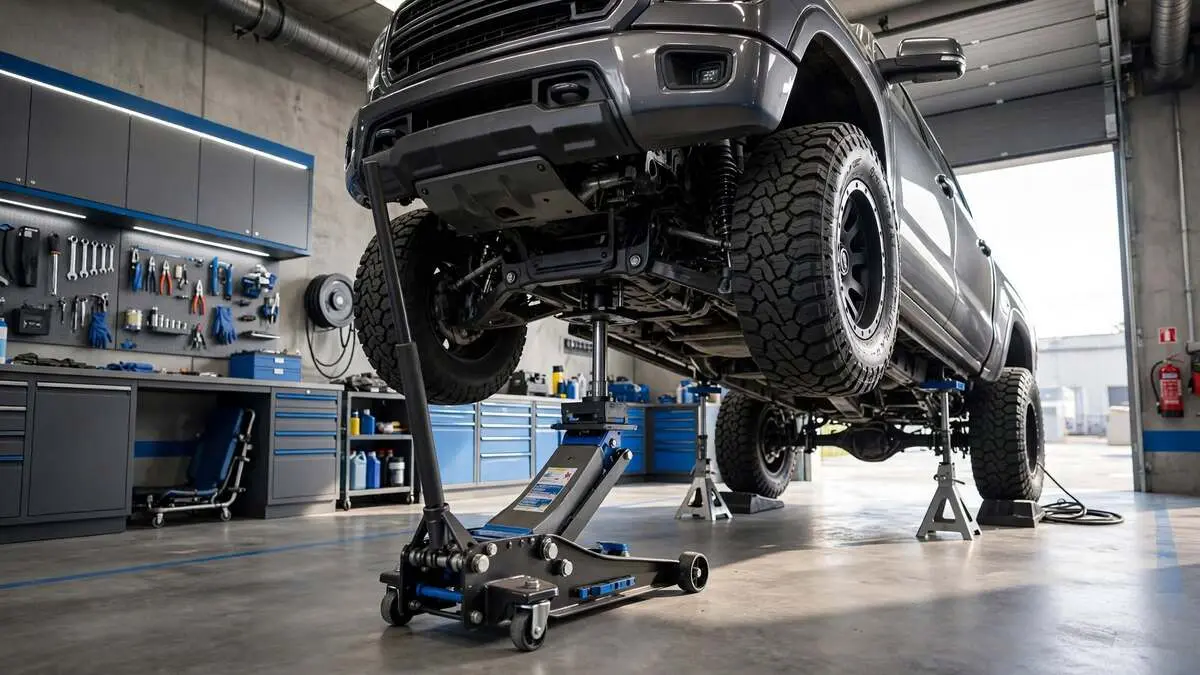
Quick Summary: Most stock 3-ton floor jacks max out around 17–19 inches, which isn’t enough for a lifted truck or SUV’s higher pinch welds and frame rails. The fix is a long-reach 3-ton jack with 20+ inches of max lift height and a low enough entry height to still slide under stock ride height. Expect to spend 15–30 minutes researching and $120–$350 for a quality unit, a fraction of what a shop charges just to lift your vehicle for basic maintenance.
Tools & Parts Needed
| Item Required | Recommended Tool / Part | Primary Use |
|---|---|---|
| Floor jack | 3-ton hydraulic jack, 20+ in. max lift height (steel or aluminum-hybrid) | Raises the vehicle off the ground |
| Jack stands | Rated 3-ton (6,000 lb) jack stand pair, tall/extended-height style | Supports the vehicle safely — never work under a jack alone |
| Wheel chocks | Rubber or steel wheel chocks | Prevents rollaway on the opposite end of the vehicle |
| Lug wrench/breaker bar | 1/2-inch drive breaker bar with impact socket set | Loosens lug nuts before fully lifting the wheel off the ground |
| Torque wrench | Click-style torque wrench (0–150 lb-ft) | Re-torques lug nuts to spec after lowering the vehicle |
| Jack extension/saddle adapter (optional) | Puck-style lift adapter or extended saddle pad | Bridges the extra gap created by lift kits and aftermarket bumpers |
| Gloves and eye protection | Mechanic’s gloves, safety glasses | Basic hand and eye protection while working under the vehicle |
| Owner’s manual | Manufacturer service manual or online reference | Confirms your vehicle’s factory-rated lift/jack points |
Why Stock Jacks Fail on Lifted Trucks and SUVs
Before you shop, it helps to understand exactly why your garage jack is struggling — most complaints trace back to one of these issues:
- Insufficient max lift height. A 2–6 inch lift kit raises your frame rails and pinch welds well above where a standard 17-inch jack can reach. If the jack bottoms out on its travel before the tire clears the ground, it simply can’t do the job.
- Wrong jack points for aftermarket parts. Off-road bumpers, rock sliders, and skid plates often cover or relocate the factory lift points, forcing you to reach further or use a saddle extension to find solid metal.
- Low ground clearance for the jack itself, not the truck. Ironically, some high-lift jacks are so tall in their collapsed state that they won’t fit under a truck with certain aftermarket skid plates or long-travel suspension components — always check minimum height, too.
- Undersized capacity for the vehicle’s actual corner weight. Full-size trucks and SUVs with lift kits, heavy-duty bumpers, and larger tires can push corner weight close to a 3-ton jack’s rated limit, leaving little safety margin.
- Unstable base on uneven or off-road terrain. Standard casters that work fine on a smooth garage floor can sink or roll on dirt, gravel, or a job site — a real issue if you’re doing trailside repairs.
Steel vs. Aluminum vs. Off-Road: Which Type Fits Your Situation
| Jack Type | Best For | Trade-Off |
|---|---|---|
| All-steel, dual-piston | Daily garage use, maximum durability, tightest budget | Heaviest option (60–90 lbs); harder to carry |
| Aluminum-steel hybrid | Buyers who want less weight without sacrificing much strength | Slightly higher price than comparable all-steel jacks |
| High-lift “off-road” jack (skid plate base, wide stance) | Lifted 4x4s, trail repairs, soft or uneven ground | Bulkier and pricier; overkill for a daily-driver garage jack |
| Low-profile 3-ton | Garages that also service lower cars or crossovers alongside a truck | Usually tops out lower (around 19–20 in.) than dedicated high-lift models |
Step-by-Step: Choosing and Safely Using a 3-Ton Jack on a Lifted Vehicle
Safety first: Always work on a flat, level, hard surface, chock the wheels on the opposite end of the vehicle, and never get underneath a vehicle supported only by a hydraulic jack — always transfer the load to rated jack stands before you start wrenching.
- Step 1: Confirm Your Vehicle’s Corner Weight and Jack Points: Check your owner’s manual for the factory-rated frame or axle jack points, and verify your truck’s curb weight so a 3-ton (6,000 lb) jack gives you a comfortable safety margin per corner.
- Step 2: Measure Your Required Lift Height: Measure from the ground to your frame rail or lowest solid lift point with the tires you plan to have on. For most lifted half-ton trucks and SUVs, look for a jack rated to at least 20 inches of max height; heavily lifted 4x4s may need 24–29 inches.
- Step 3: Match Minimum Height to Your Lowest Clearance Point: Even lifted trucks can have low-hanging skid plates, tow hooks, or differential covers. Confirm the jack’s collapsed height (typically 3–6 inches) will still slide underneath.
- Step 4: Position the Jack and Chock the Wheels: Park on level, solid ground, engage the parking brake, and chock the wheels diagonally opposite the corner you’re lifting.
- Step 5: Loosen the Lug Nuts Slightly (If Changing a Wheel): Break the lug nuts loose about a quarter turn while the tire still has weight on it, before you start lifting.
- Step 6: Raise the Vehicle Smoothly: Pump the handle in slow, even strokes until the saddle contacts the rated lift point, double-check alignment, then continue lifting until you reach your target height.
- Step 7: Place Jack Stands and Transfer the Load: Slide rated jack stands under the frame or axle, then slowly lower the jack until the vehicle’s weight rests on the stands, not the jack.
- Step 8: Complete Your Work and Reverse the Process: Finish your repair or maintenance, then jack the vehicle up just enough to remove the stands, lower it fully, and torque lug nuts to your manufacturer’s spec in a star pattern.
Cost Breakdown: DIY vs. Mechanic Shop
| DIY (Buy Your Own Jack) | Mechanic Shop | |
|---|---|---|
| One-time equipment cost | $120–$350 (3-ton long-reach jack) | $0 (shop already owns lifts) |
| Jack stands (pair) | $40–$90 | Included |
| Cost per visit going forward | $0 — reusable indefinitely | $20–$60 “shop fee” just to lift the vehicle, even before labor |
| Typical use case | Tire rotations, brake jobs, oil changes, trail repairs | One-off jobs or work requiring a full lift/alignment rack |
Total Estimated Savings: After 3–4 uses, a quality 3-ton jack typically pays for itself compared to repeated shop lift fees — and it’s available in your driveway 24/7.
3-Ton Floor Jack Comparison for Lifted Trucks and SUVs
Frequently Asked Questions (FAQs)
Is a 3-ton floor jack strong enough for a full-size lifted truck? Yes, for the vast majority of half-ton trucks and SUVs — a 3-ton (6,000 lb) jack lifts one corner at a time, and even a heavy truck rarely puts more than 2,500–3,000 lbs on a single corner. Trucks with heavy-duty bumper/winch combos or 3/4-ton-and-up ratings should consider a 4-ton jack for extra margin.
How much lift height do I actually need for my lift kit? As a rule of thumb, add your lift kit’s height plus 4–6 inches of working clearance to your stock jack point height, and look for a jack rated at or above that number. Most 4–6 inch lift kits are comfortably served by a jack with a 20–24 inch max height.
Can I use the same 3-ton jack for a lifted truck and a regular sedan? Yes, as long as the jack’s minimum (collapsed) height is low enough to slide under the sedan, which is typically 3–4 inches on most quality 3-ton jacks. Just confirm both the minimum and maximum height specs before buying if you plan to service multiple vehicle types.
Are aluminum jacks reliable enough for a lifted truck, or should I stick with steel? Aluminum-hybrid jacks from reputable brands are plenty strong for a properly rated 3-ton load and are much easier to carry and store. Choose all-steel construction instead if your top priority is maximum long-term durability over portability.